
Bidirectional charging: Which cars are suitable for electricity storage and what is the legal situation in Germany?
The sun is shining, the solar roof is running at full speed, but where to put the excess electricity? The best way is to get into an e-car. The electricity stored there can be easily fed back into the home power grid if necessary and makes lamps light up and TVs running. How does that work? The magic word is bidirectional charging.
⏰ In a nutshell
- E-car can act as an energy storage system
- It is possible to feed it back into the electricity or domestic power grid
- Only certain charging stations offer the necessary technology
- Asian manufacturers are pioneers
- Special wallboxes are necessary for V2H
- Legal situation in Germany: no double taxation
So far, this type of charging has not yet fully caught on, but if you still want to look for an electric car, here are some offers for you:
| Model | Offers from | |
| Skoda Elroq | €28,110 | Compare offers |
| Kia EV3 | €27,240 | Compare offers |
| Cupra Born | 30.170 € | Compare offers |
| BMW iX1 | €38,224 | Compare offers |
| BYD Dolphin Surf | €20,042 | Compare offers |

Bidirectional charging: E-car as electricity storage?
Bidirectional charging means that energy is exchanged in both directions. The electric car can not only be charged with electricity, but also emit electricity. In the meantime, the e-car acts as an energy storage device, so to speak.
The first thing you have to know is that an electric car only runs on direct current, because the battery is only designed for this. Therefore, the alternating current from the power grid must be converted into direct current. If the car is stationary for a while and the power is not consumed, the battery simply stores the electricity.
If you now want to use the electricity from the e-car battery for house lighting, for example, the direct current must be converted back into alternating current. This is exactly what this charging process is all about, because it is no problem for appropriately designed chargers to achieve this.

Is bidirectional charging allowed in Germany?
Yes, bidirectional charging is allowed in Germany. The corresponding EU directive was already transposed into national law in 2019.
What are the areas of application for bidirectional charging?
There are three ways to use the energy stored in the e-car for other purposes:
Vehicle-to-home (V2H)
Those who decide to do this want to use the stored electricity to supply the home power grid. A converter that produces alternating current from direct current is usually integrated into the wallbox. Your electric car charges the in-house photovoltaic system, and the e-car was ideally fed by the solar system beforehand. Thus, the entire cycle is free of charge and sustainable for you.
Vehicle-to-grid (V2G)
This method is used to think bigger. This means integrating as many electric cars as possible into the energy grid. The energy stored in the electric car is to be fed back into the general power grid. This makes sense, for example, to counteract power peaks. If you charge the e-car during off-peak hours, you can return the energy at peak times to relieve the power grid.
Of course, you can also drive in the meantime, but most vehicles are parked a good 90 percent of the time, so it makes sense to use the V2G option. The e-car is thus used as an electricity storage device.
Vehicle-to-load (V2L)
As a third option, vehicle-to-load is a type of bidirectional charging. Here, the e-car provides power for other devices – e.g. laptop, smartphone or e-bike. There is a socket in the car where you can plug in the devices and charge them.
Which cars can charge bidirectionally?
The pioneer for this charging technology is Nissan, because the Nissan Leaf has been able to charge bidirectionally as an electric car for several years. In general, it can be said that models from Asian manufacturers are more often suitable for this, because the CHAdeMO connector, which is widely used in the Asian region, was designed for this from the beginning. Only for this connection is there currently a valid protocol for V2G charging in order to feed electricity into the public grid.
The CCS standard, which is widespread in Europe, usually does not yet master this.
The following models can currently (as of 12/2025) charge bidirectionally:
| Model | Art | Note |
| BMW iX3 | V2G | |
| Cupra Born | V2H | only with 77 kWh battery & latest software 3.5 |
| Cupra Tavascan | V2H | only with 77 kWh battery & latest software 3.5 |
| Ford Explorer | V2H | |
| Ford Capri | V2H | |
| Genesis Electrified GV60 |
V2L | Adoption of V2H and V2G expected in the next generation |
| Genesis Electrified G80 |
V2L | Adoption of V2H and V2G expected in the next generation |
| Genesis Electrified GV70 |
V2L | Adoption of V2H and V2G expected in the next generation |
| Hyunai Ioniq 5 | V2L | |
| Hyundai Ioniq 6 | V2L | |
| Hyundai Ioniq 9 | V2L | |
| Hyundai Kona Electric | V2L | |
| Kia EV6 | V2L | |
| Kia EV9 | V2L | |
| Kia Niro EV | V2L | |
| MG4 | V2L | |
| MG5 | V2L | |
| Nissan Leaf | V2H/V2G (prepared) | |
| Mitsubishi Outlander | V2H/V2G (prepared) | |
| Polestar 3 | V2L/V2H/V2G (prepared) |
|
| Renault 5 E-Tech | V2G | |
| Skoda Elroq | V2H | |
| Skoda Enyaq | V2H | only with 77 kWh battery & latest software 3.5 |
| Volvo EX90 | V2L/V2H/V2G (prepared) |
|
| VW ID.3 | V2H | only with 77 kWh battery & latest software 3.5 |
| VW ID.4 | V2H | only with 77 kWh battery & latest software 3.5 |
| VW ID.5 | V2H | only with 77 kWh battery & latest software 3.5 |
| VW ID.7 | V2H | only with 77 kWh battery & latest software 3.5 |
| VW ID.7 Tourer | V2H | only with 77 kWh battery & latest software 3.5 |
| VW ID.Buzz | V2H | only with 77 kWh battery & latest software 3.5 |
| XPeng G6 | V2L | |
| XPeng G9 | V2L |
The Ioniq 5 and its sister model EV6 confirm the exception to the CCS standard. The two models can also charge bidirectionally with this charging standard. However, Hyundai and Kia are not yet focusing on this charging technology in development. However, it would be possible to charge external devices with up to 3.7 kW via an adapter on the CCS connection. Accordingly, other electric cars could also be given jump start.
Does a Tesla support bidirectional charging?
No, currently no Tesla model supports bidirectional charging.
Are there plans for bidirectional charging at VW?
Since the end of 2023, some ID. models have supported bidirectional charging. If you have a new ID. model with a 77 kWh battery, then the vehicle is equipped with bidirectional charging. For vehicles already delivered, the function should also be possible by means of an update to ID. Software 3.5.
How can you charge bidirectionally with the new BMW iX3 and E.on?
BMW and E.ON have jointly presented a new concept for bidirectional charging of electric cars. This technology makes it possible not only to charge electric cars, but also to feed electricity back into the grid or into the home. This allows vehicle owners to use their batteries as mobile power storage systems, which increases the flexibility and efficiency of energy use.
This will be possible for owners of the new BMW iX3 from spring 2026. All customers who register for this service receive a bonus of 720 euros per year – the equivalent of about 14,000 free kilometers.
What technical requirements do you need?
It is important that all parameters involved communicate with each other, i.e. that they can understand each other and work together. The following three conditions must be met:
- An electric car
- A suitable charging infrastructure or wallbox
- A uniform language – i.e. software
An electric car is best suited for the purpose of bidirectional charging, plug-in hybrid models can do that too, but are rather negligible for the future. They only have a small battery that can store only a small amount of electricity.
In order for this technology to be implemented on a large scale, a suitable charging infrastructure is needed. This refers to both public charging stations and wallboxes for home use. These devices must convert alternating current into direct current, produce the correct voltage and have a suitable communication standard.
That brings us to the language. As already mentioned, only the CHAdeMO standard is currently designed for bidirectional charging. CCS is catching up, but still has a lot of catching up to do.
Bidirectional wallbox: What models are there?
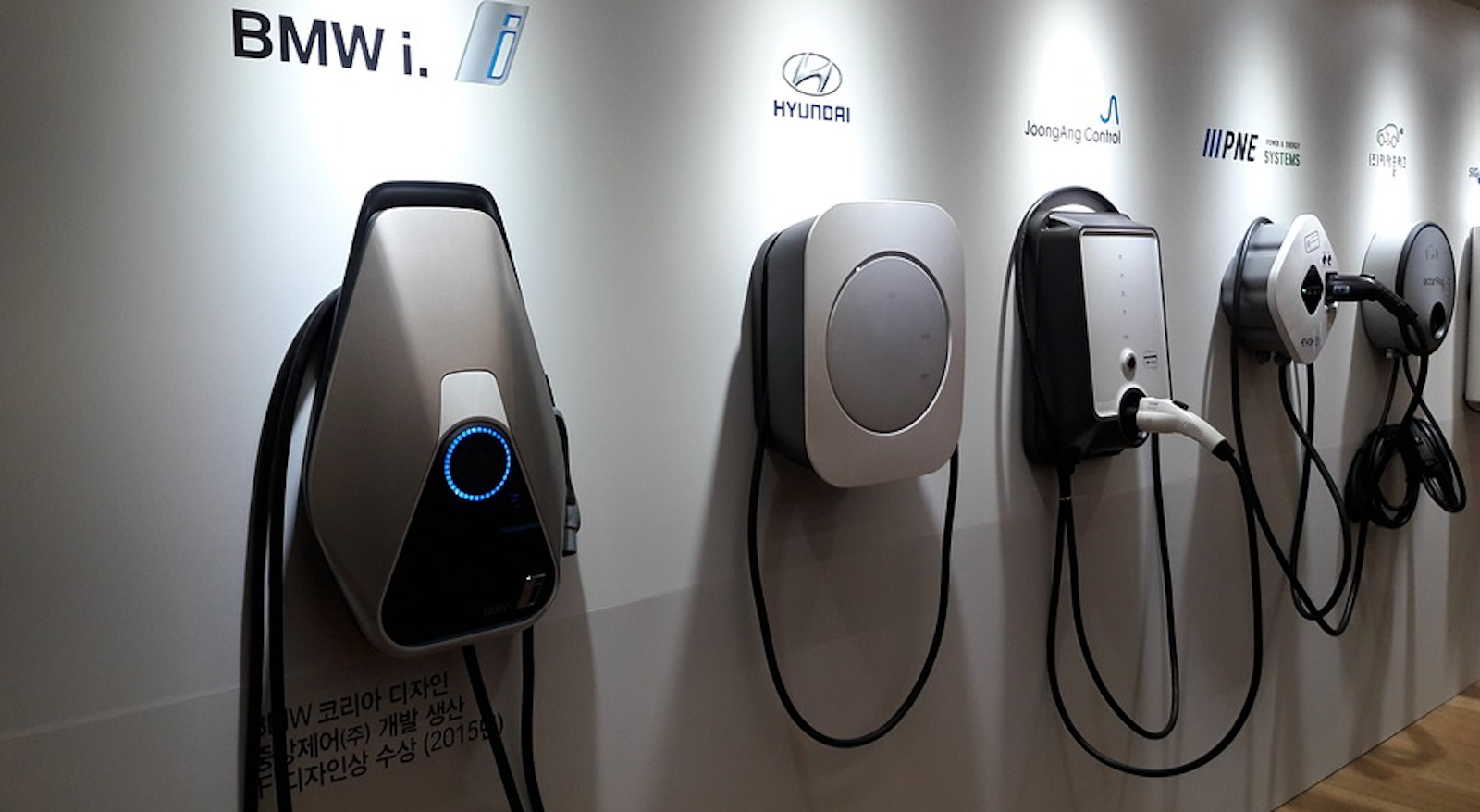
In the meantime, there are already some wallboxes that support bidirectional charging. Here is a selection of providers and corresponding wallboxes:
- openWB Pro
- Smartfox Pro Charger 2
- E3/DC Edison BiDi Wallbox
- Evtec sospeso&charge
- Sigenergy Sigen EV DC Charging Module
- VW bidirectional ID. Charger
- Ford Charge Station Pro
- Sono Wallbox
- go-e Charger PRo
By the way: If you would like to fill up with cheap car electricity, then take a look at the tariffs of our car electricity partners.

Bidirectional charging in Germany – current legal situation
It's the same as always when new technologies come onto the market – the federal government has to adapt laws. Until now, owners of an e-car with a matching wallbox had to pay twice when using V2G technology. The flowing electricity was subject to double taxation – once because it was taken from the grid and a second time when it was fed into the grid.
So why should you sell the electricity again and feed it into the power grid if you are punished twice for it? The government has also recognized this.
No more double taxation for V2G
In November 2025, the Bundestag passed a resolution that provides for the following: When storing electrical energy in electrical, chemical, mechanical or physical electricity storage systems, no grid fees and electricity taxes are incurred if the recovered energy is fed back into the same electricity grid with a delay.
In simple terms, this means that it will now even be attractive for e-car owners to feed electricity back into the grid – because they get money back for the sale and no longer have to fear double taxation. This regulation will apply from January 2026.
Energy transition and the environment: What can bidirectional charging contribute?
Producing electricity only sustainably is a major challenge. Especially when it comes to the changing weather, because solar and wind energy are not yet sufficiently available, especially in winter. A large number of electric cars that are integrated into the power grid and serve as buffer storage could have a real effect here.
If the batteries of the e-cars are charged when there is enough sun or wind available and this energy is then fed back into the power grid in bad weather or when there is no wind, the share of renewable energies in our power grid would be increased.

Posting Komentar